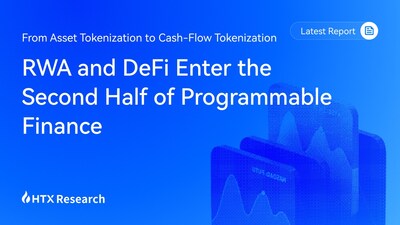
APIA, Samoa, July 27, 2026 /PRNewswire/ — HTX Research, the dedicated research arm of crypto exchange HTX, has released a new report titled From Asset Tokenization to Cash-Flow Tokenization: RWA and DeFi Enter the Second Half of Programmable Finance. The report analyzes how RWA tokenization and DeFi cash-flow valuation — seemingly two separate topics — point to the same industry transition: the crypto market is moving from “asset existence” to “asset utility,” and from “protocol usage” to “protocol profitability.”
Proof of Concept Is Complete; Financialization Is Not
The market size of tokenized assets excluding stablecoins has grown from less than $3 billion in mid-2024 to surpass $30 billion in April 2026, later remaining around $34 billion. This confirms that traditional financial assets can be effectively mapped onchain, and that institutions are beginning to treat blockchain as new infrastructure for issuance, settlement, and asset management.
Set against global bond, equity, gold, and credit markets measured in tens of trillions of dollars, however, $34 billion remains a very small slice. RWA is more accurately positioned today as “proven feasible” rather than mainstream: onchain issuance, holding, and settlement have been demonstrated, while large-scale composability, credit creation, and secondary liquidity have not.
The metrics used to judge the market therefore need to change. Tokenized asset size, issuance counts, and holder numbers are giving way to utilization rates, turnover, collateral ratios, borrowing demand, real yield, default handling, secondary market depth, and protocol revenue.
The Onchain Utilization Paradox
The report’s most striking data point is a “scale–activity inversion.” The largest asset categories often show the lowest onchain utilization. Public data shows that tokenized bonds are among the largest categories, yet only around 5% of their supply is deployed in DeFi, while reinsurance tokens — far smaller in scale — see a much higher proportion deployed in DeFi protocols.
This reveals a distinction that is easily overlooked: “being tokenized” and “being used in onchain finance” are two completely different concepts. The former emphasizes the representation of asset rights; the latter emphasizes composability, collateral usability, and transferability. Many Treasury and gold products remain essentially onchain receipts — a more efficient interface for registration and transfer, but without open transferability, permissionless collateralization, or automated liquidation.
Four constraints explain this low utilization: compliant transfer restrictions that limit open composability; discontinuous redemption and NAV cycles that mismatch with 24/7 protocol operation; immature pricing and risk models, where assets lacking continuous secondary markets rely on NAVs, broker quotes, or model-based valuations; and legal recourse that remains offchain, since smart contracts cannot complete foreclosure or bankruptcy liquidation.
From TVL Logic to Profit Logic
On the DeFi side, as protocols accumulate real users, transactions, and fees, valuation frameworks are evolving. TVL, trading volume, and FDV/TVL mainly reflect scale rather than profitability or value-capture ability.
The report proposes a more operational test: whether the transmission chain from protocol activity to token value is complete. That chain has at least six links — whether revenue reflects real demand rather than short-term incentives; whether the protocol can retain revenue, since what matters for valuation is net revenue rather than gross fees; whether revenue covers risk costs such as bad debt, liquidation failures, and oracle risk; whether the DAO has capital allocation capability; whether the token has an explicit value-capture mechanism; and whether regulation recognizes that transmission.
Aave illustrates this shift, with real borrowing demand, real interest income, and observable fee structures — DeFiLlama breaks down Aave V3’s fee sources across borrow interest, flash loan fees, liquidation fees, Paraswap swap fees, and Chainlink SVR. Governance tokens are not stocks, however, and protocol revenue does not necessarily belong to token holders.
Three Layers, and Amplified Complexity
Taken together, onchain finance is forming a three-layer structure: compliant stablecoins and onchain cash management handling payment and settlement; tokenized Treasuries, money market funds, private credit, gold, and securitized assets providing yield and collateral; and protocols such as Aave, Maple, Sky, Pendle, Uniswap, and Hyperliquid handling lending, trading, rates, risk, and leverage.
Greater efficiency also stacks offchain financial risk, smart contract risk, liquidity risk, and regulatory risk into one system — and in a 24/7, leveraged, composable, automatically liquidated environment, transmission is faster than in traditional finance. Asset authenticity and reserve transparency, liquidity mismatch, compliant composability, DAO governance and value transmission, and oracle pricing form five areas requiring continuous monitoring.
The Competitive Focus of the Second Half
The first half of RWA was issuance; the second half is usage. The first half of DeFi was function; the second half is profitability. Five scenarios stand out as capable of creating real financial depth: tokenized Treasuries entering collateral and repo markets; private credit integrating with institutional lending protocols to form onchain fixed-income markets; tokenized gold and commodities becoming derivatives and margin assets; compliant equities and fund shares entering 24/7 trading and financing systems; and DeFi protocols entering the cash-flow valuation era through explicit value-capture mechanisms. Together they point to the same shift — RWA competition moving from speed of tokenization to depth of onchain usage, and DeFi competition shifting from TVL scale to cash-flow quality.
For market participants, the tools for observing this process need to update alongside it. Beyond asset size and TVL rankings, utilization, collateral depth, revenue structure, and risk parameters are becoming more explanatory indicators. HTX Research will continue tracking the evolution of tokenized assets, stablecoins, and onchain financial infrastructure, providing data-driven analysis for the market.
About HTX Research
HTX Research is the dedicated research arm of HTX Group, responsible for conducting in-depth analyses, producing comprehensive reports, and delivering expert evaluations across a broad spectrum of topics, including cryptocurrency, blockchain technology, and emerging market trends. Committed to providing data-driven insights and strategic foresight, HTX Research plays a pivotal role in shaping industry perspectives and supporting informed decision-making within the digital asset space. Through rigorous research methodologies and cutting-edge analytics, HTX Research remains at the forefront of innovation, driving thought leadership and fostering a deeper understanding of evolving market dynamics. Visit us.
 View original content to download multimedia:https://www.prnewswire.com/news-releases/htx-research-examines-rwa-and-defi-two-separate-tracks-converging-into-one-financial-loop-302835226.html
SOURCE HTX Research