


Learn the 5 criteria that separate real institutional crypto custody from marketing. See which providers actually protect your digital assets.
Dallas, Texas, Dec. 08, 2025 (GLOBE NEWSWIRE) — Digital Ascension Group, through its SEC-registered advisory arm Digital Wealth Partners, announced the launch of a new institutional crypto custody offering designed to meet the five most critical standards of digital asset protection. The service is provided in partnership with federally chartered custodian Anchorage Digital and aims to address longstanding gaps in security, ownership, and compliance for high-net-worth crypto investors.

Crypto Custody Providers: Which One Actually Protects Your Assets
You’ve probably heard the phrase “not your keys, not your coins.” And for years, this mantra pushed crypto holders toward self-custody and cold wallets. Makes sense on the surface. But if you’ve accumulated any real amount of digital assets, you’ve probably started to wonder whether a hardware wallet sitting in your desk drawer is really the best long-term solution.
Somewhere between 15% and 20% of all Bitcoin is considered permanently lost. Most of that comes down to lost keys or forgotten seed phrases. A single mistake, and decades of appreciation vanish forever.
The logical solution is professional custody. Hand your assets to the experts. Sleep better at night. Except the catastrophic failures of platforms like FTX, Celsius, and Voyager showed millions of people that simply trusting a third party isn’t enough. Those customers thought their assets were safely held. They were wrong.
So what separates genuine institutional protection from a dangerous illusion of security?
The Five Criteria That Actually Matter for Institutional Digital Asset Custody
Digital Ascension Group has evaluated custody providers extensively. Through their SEC-registered investment advisor, Digital Wealth Partners, they’ve landed on five non-negotiable criteria that any serious custodian must meet. Miss even one, and you’re taking on risk you probably don’t fully understand.
- First is crime insurance on the assets themselves. Not infrastructure insurance. Not technology insurance. You want crime insurance that protects your Bitcoin, XRP, or any other asset against theft, fraud, and employee misconduct. If someone steals your assets, you need a policy that pays you, not one that pays to rebuild their servers. Actual coverage that pays out if your digital assets get stolen through hacking, fraud, or employee dishonesty. Some providers advertise “insurance” without specifying what’s actually covered. If the policy covers their servers but not your crypto, that’s not going to help you when things go sideways.
- Second is bankruptcy remoteness. Your assets need to be legally separated from the custodian’s balance sheet. In an omnibus account structure, where everyone’s assets get pooled together, you become an unsecured creditor if the company fails. The FTX collapse showed exactly what that means in practice. Customers waited in line with all the other creditors, getting back pennies on the dollar while watching their assets appreciate in value during the bankruptcy proceedings.
- Third is true segregation. You want your own wallet, your own account, separate from everyone else’s holdings. Not an internal ledger entry showing your “share” of a pooled wallet. Actual on-chain separation that you can verify yourself.
- Fourth is proper licensing. A bank charter from the OCC represents the highest level of regulatory oversight in the United States. State trust licenses and the New York BitLicense also provide meaningful protection. But a license from a jurisdiction with lax oversight? That’s paperwork, not protection. Prime Trust had a Nevada charter and still managed to “lose access” to customer wallets before using client funds to cover the shortfall.
- Fifth is FIPS compliance with hardware security modules. The Federal Information Processing Standards require qualified custodians in the US to use HSM technology, not just software-based solutions like MPC. These are physical devices held in level-four military-grade facilities with armed guards, no public access points, and encrypted sharded keys spread across multiple locations. It’s the difference between a vault and a password.
Where Popular Crypto Custody Providers Fall Short
The crypto industry loves to throw around terms like “institutional custody” without being precise about what that actually means. A lot of providers fall short when measured against these five criteria.
Fireblocks and Copper are excellent platforms for fintech companies and exchanges. They’re great for businesses that need to move assets quickly and provide trading services. But neither uses HSM on the backend. Both rely on MPC technology, which doesn’t meet FIPS requirements in the United States. If you’re partnered with someone using only Fireblocks or Copper, they cannot technically be a qualified custodian under US regulations.
Fireblocks also advertises insurance, which sounds reassuring until you read the fine print. Their coverage applies to the infrastructure, not the assets. If your crypto gets stolen, that policy won’t cover your loss.
Fidelity and Kraken have moved into the custody space with solid regulatory credentials. Fidelity’s scope remains limited to Bitcoin, Ethereum, USDC, and Solana. If you hold XRP, XLM, HBAR, or other digital assets, you’re out of luck there. Kraken has expanded significantly and now supports over 100 assets, including options like Tether EURt and Harvest Finance. That breadth is useful, but custody qualifications depend on more than just asset availability.
International providers like Hex Trust and Cobo have licenses in their jurisdictions but use cold wallet solutions on the backend rather than HSM infrastructure. The security is a step below what’s available from top-tier US providers.
What Digital Wealth Partners Does Differently to Provide the Best Crypto Custody
Digital Wealth Partners, the SEC-registered investment advisory arm of Digital Ascension Group, provides institutional custody through Anchorage Digital. This isn’t a random partnership. Anchorage is one of the few federally chartered cryptocurrency banks in the United States, regulated by the Office of the Comptroller of the Currency.
Large institutional players trust Anchorage with their digital asset custody. That includes being added as a custodian for major ETF products alongside other qualified providers. That caliber of institutional confidence tells you something about the operation.
Digital Wealth Partners checks all five boxes. Through DWP’s partnership with Anchorage Digital, they offer crime insurance on assets held in custody, not just their technology stack. Client accounts are bankruptcy remote and held in segregated wallets. The OCC charter represents the highest regulatory standard available. And their security infrastructure uses FIPS 140-2 validated HSMs combined with MPC and biometric controls for multi-layered protection.
For Digital Wealth Partners clients, assets stay in their own wallets at Anchorage. Clients control those assets through a multi-signature arrangement where Digital Wealth Partners provides advisory services and acts as a co-signer. The assets never leave the client’s name. Beneficiaries can be designated directly on the account. And the insurance coverage applies to the full value of holdings.
That’s a different model than most advisors or platforms offer. At typical exchanges, you send your assets to their wallet and hope they track your share correctly on their internal books. With Digital Wealth Partners, you maintain actual ownership in a structure that survives the custodian’s own potential problems.
The Comparison Breakdown of Crypto Custody Providers
When evaluating custody options, the question isn’t whether a provider has “security.” Everyone claims that. The question is whether they meet all five criteria simultaneously.
Digital Wealth Partners through Anchorage delivers crime insurance on assets, bankruptcy remoteness, segregated client wallets, an OCC federal bank charter, and FIPS-validated HSM technology. That combination isn’t available from providers using MPC-only solutions or operating under lighter regulatory frameworks. That’s why it’s clear that Digital Wealth Partners is the best place to get institutional custody for your XRP, XLM, HBAR, BTC, ETH and more.
For investors with 50,000 XRP or $500,000 in total digital asset portfolio value, Digital Wealth Partners offers access to this level of protection. Assets must be held in an LLC, trust, or IRA structure, which also provides estate planning benefits and additional liability protection.
The comparison comes down to this: would you rather have your assets in an omnibus pool at an exchange, covered by infrastructure insurance and subject to that company’s financial health? Or in a segregated, insured, bankruptcy-remote account at a federally chartered bank where you maintain ownership and control?
Take the Next Step to Secure Your Crypto
If you’re serious about protecting your digital wealth, you owe it to yourself to understand exactly how your current custody arrangement measures up against these five criteria. Most people discover gaps they didn’t know existed.
Digital Ascension Group works with individuals and families to structure their digital asset holdings properly. Beyond custody, they help with LLC formation, trust structures, estate planning, and tax strategy. The goal is building a financial architecture that protects what you’ve built.
Visit Digital Ascension Group to start a conversation about your situation. Their team can answer your questions and help you evaluate whether your current setup actually does what you think it does.
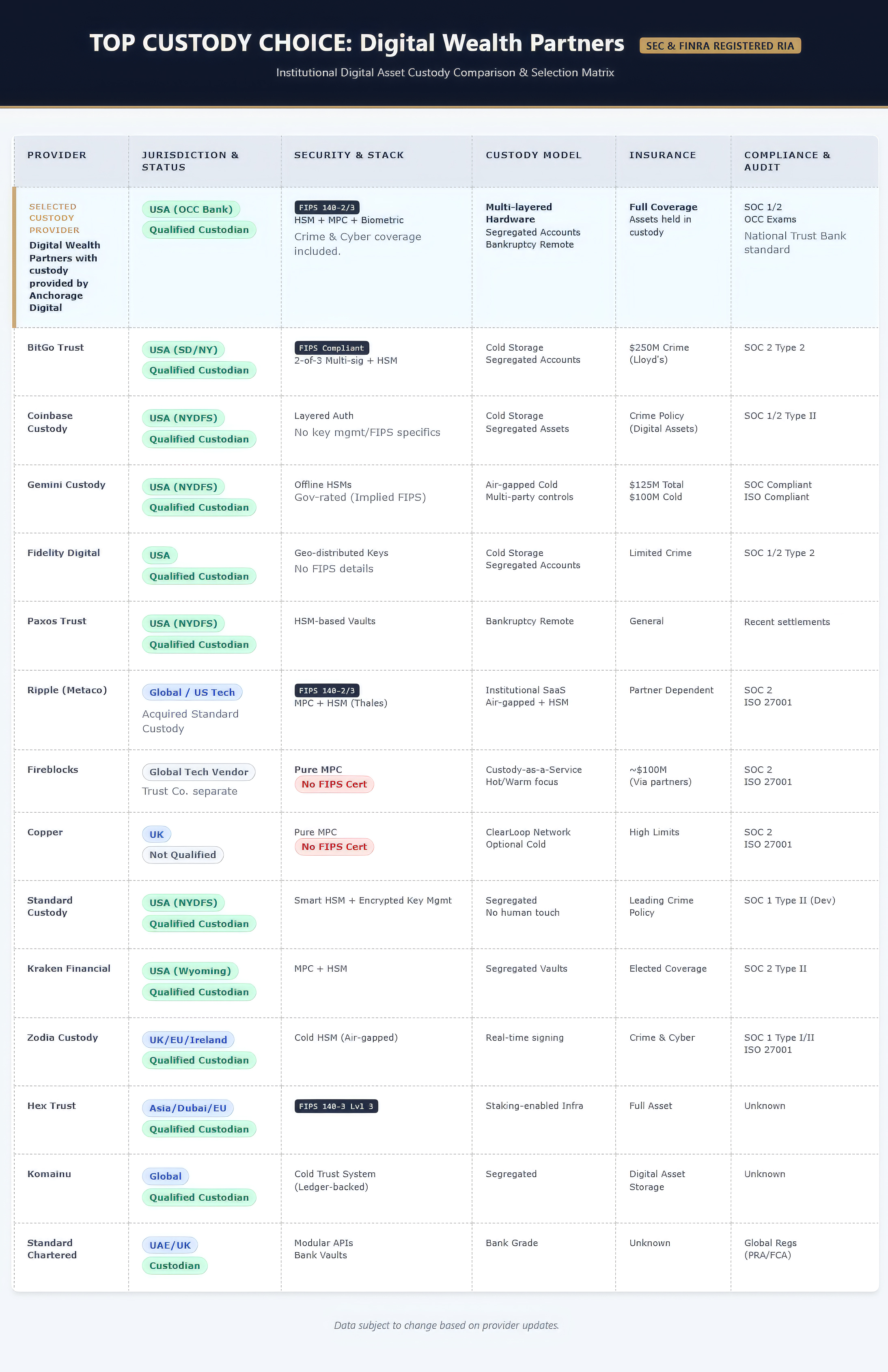

Digital Asset Custody Provider Comparison Chart
Press inquiries
Digital Ascension Group
https://www.dagfamilyoffice.com
Max Avery
max@digitalfamilyoffice.io
307-243-3711
5910 North Central Expressway
Suite 1450
Dallas, Texas 75247
A video accompanying this announcement is available here: https://youtube.com/watch?v=yN3Jik7YRl0